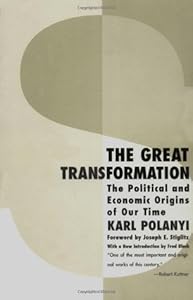
The Great Transformation: The Political and Economic Origins of Our Time By Karl Polanyi
I read this a few years ago.
I've been thinking about it again after reading Streeck's stunning How Will Capitalism End?
Maybe the key concept here is embeddedness (https://en.wikipedia.org/wiki/Embedde...)
Capitalist society relies on pre-capitalist social formations to sustain itself. The market on its own is an insufficient foundation for the spiritual and social bonds that constitute a people (as opposed to just an aggregate of individuals).
Thus (it may follow) the total triumph of capitalism will also be its dissolution. Contra most Marxists, the end of capitalism does not require a revolutionary subject to take its place. Just the opposite, capitalism will deteriorate after it has eliminated all opposition. Chaos reigns.
*
This book was actually published the same year as Road to Serfdom.
Polyani > Hayek
( > Marx? to me, that seems like an open question; at the moment it almost seems equally radical to call for a new New Deal as a second Bolshevik revolution )
http://prospect.org/article/karl-pola...
'Hayek contended in The Road to Serfdom that even democratic forms of state planning were bound to end in the totalitarianism of a Stalin or a Hitler. But 70 years later, there is not a single case of social democracy leading to dictatorship, while there are dozens of tragic episodes of market excess destroying democracy. '
TRUTH. What starts with 'free' markets does not end in freedom. 360 Just re-read this book from start to finish and I could not believe how relevant it is. This may be the most important book written this century. While some parts are obviously outdated, his thorough takedown of neoliberalism, myths of colonization and money are essential. The fact that we’re still only reading Adam Smith or Marx is a tragedy. 080705643X I wouldn't think of reading this book without a guide. Because Polanyi is an impossible read -- more difficult than Marx (he doesn't have Marx's love of language or Marx's humor), more difficult than Hegel (he doesn't have Hegel's pointed sense of knowing that his prose is torturing the poor reader). If you have ever tried to read Aristotle, then you have some idea of how Polanyi writes -- tear-duct vaporizing dry.
But you get something here you won't get in hegel or marx (in part because he is building on them). What you get is this: the claim that markets and socialism are simultaneous in their emergence. Not markets against socialism, but markets AND socialism -- from the beginning and always. The bold claims is that without socialism (of various types) a pure market society couldn't exist for more than 20 years. Markets would destroy the very elements they thrive upon -- human beings.
What we get from Polanyi is that the temporal separation of stages that the Scottish Enlightenment figures (Smith, Hume, Ferguson, etc.), hegel, and marx deployed, is replaced in Polanyi by the overlaps of stages. The past, present, and future coexist in simultaneous determinacy. Its a revolutionary move.
There is more. Much, much more. The Great Transformation is a book that one reads over and over through a lifetime. Its mix of theory, history, and wisdom is unparalleled in any other book I have read. Hegel's and Marx's theoretical insights are deeper and perhaps more precise. But Polanyi is superior -- I believe -- in one important dimension: he treats the third world with reverence, as a fount of knowledge, as a living resource.
(His honoring of the third world comes across more in other works -- see, Primitive, Archaic, and Modern Economies: Essays of Karl Polanyi;
Trade and Market in the Early Empires; and
Dahomey and the Slave Trade: An Analysis of an Archaic Economy.
I mention all this about Polanyi because the current popular heir to his work is Naomi Klein's excellent The Shock Doctrine.
So read Klein, then get your hands on some secondary literature on Polanyi. You might start with chapter 5 of my book with David Blaney International Relations and the Problem of Difference. Or you could start with a short and excellent overall sketch in The Economic Thought of Karl Polanyi: Lives and Livelihood, by James Ronald Stanfield. 360 I foolishly took it upon myself to read not only the assigned chapters, but the whole of Polanyi's magnum opus, and for the past few days have been lost in the labyrinth of 19th-century poor laws and monetary policy in the Weimar Republic. But this book was immensely profitable, if I may borrow a market-based metaphor.
In particular, three of Polanyi's simplest, most commonsensical contentions were extremely illuminating to me and greatly bolstered my ability to criticize capitalist orthodoxy.
The first, on page 48, is Polanyi's contention that the concept of man that Adam Smith and the economists after him put forth, of man as naturally engaging in trade and barter to further his economic interest, is pure invention. Far from being a simple description of man's nature, it is thoroughly unnatural. Man is, and throughout history has been, primarily motivated not by individual economic interests, but by social interests. His economic decisions, as well as all other decisions, were determined by his need to preserve his social status, and to conform with accepted social norms, because man is fundamentally a social being. As soon as you state this truth, it becomes blindingly obvious. Even two centuries of market dominance have been unable to overcome human nature in this respect--when we look around at what motivates people's buying and selling choices, even in the modern West, the chief factor is clearly not economic interest, but social status. Why on earth do women spend hundreds of dollars on brand-name clothing that is no more useful than nearly identical clothes that sell for a tenth the price? Why do men spend thousands of dollars on sleek sports cars to drive on crowded city roads? Clearly not economic interest, but desire for social status. The same applies to much of what drives the housing market and other huge chunks of the global economy. Marketing experts know better than to listen to the claim that man trades primarily for his economic interest; it's about time professional economists woke up to the fact as well.
Second is Polanyi's argument that land, labor, and money are of course not commodities at all--they are fictional commodities. Land and labor are simply part of the basic fabric of natural human existence; only if they are torn completely away from their natural foundations can they begin to function as commodities, but even then, nature will continually re-assert itself, and the market will never gain uncontested mastery over them. Money is naturally merely a tool to facilitate exchange; to exalt it beyond this is to subject it to dangerous pressures which it cannot bear. Of course, it is not impossible to argue that to treat these as commodities is, all in all, an advantageous innovation, but Polanyi insists that economists be honest and recognize it as an innovation. Classical economics must renounce its absurd claim to be simply an objective description of the way the world works (which is how Christian conservatives justify submission to it) and acknowledge that it is rather a bold and dangerous prescription for how to make the world work.
Third is Polanyi's argument on p. 164 and following that a society may be destroyed and misery may increase even when economically, every one is doing better and better. This pokes a big hole in the last defense of free-market capitalism--that, in the end, it benefits poor and rich alike, by causing the wages and economic prosperity of all to increase. Far more destructive to human well-being than simple economic privation, Polanyi argues, is the destruction of the social structures and norms which give human existence stability and meaning. Of course, this destruction also has economic consequences, because, as capitalism advances and individual prosperity increases, the social support systems that will protect each member of society in case of crisis disappear; the individual is left to his own resources, which, though they may have been augmented by economic progress, are insufficient for the task. This observation of Polanyi's is intensely relevant to the current world situation, where capitalist industry is taking complete control of Third World countries, often with devastating social consequences. Anti-capitalists lament the deprivation, poverty, and exploitation of the common people, while defenders of capitalism insist that, on the contrary, statistics show that these people's incomes and economic prosperity are growing. The capitalist defense may be partially true, but the whole truth is much worse than the anti-capitalist lament; the people of Kenya, Bangladesh, or Vietnam may have a higher income, but with the result of the destruction of the fabric of society, of all in man that cannot be commodified, the result, in short, that C.S. Lewis calls the abolition of man. Paperback Foreword, by Joseph E. Stiglitz
Introduction, by Fred Block
Note on the 2001 Edition
Author's Acknowledgments
--The Great Transformation: The Political and Economic Origins of Our Time
Notes on Sources:
1. Balance of Power as Policy, Historical Law, Principle, and System
2. Hundred Years' Peace
3. The Snapping of the Golden Thread
4. Swings of the Pendulum after World War I
5. Finance and Peace
6. Selected References to Societies and Economic Systems
7. Selected References to Evolution of the Market Pattern
8. The Literature of Speenhamland
9. Poor Law and the Organization of Labor
10. Speenhamland and Vienna
11. Why Not Whitbread's Bill?
12. Disraeli's Two Nations and the Problem of Colored Races
Index The Great Transformation: The Political and Economic Origins of Our Time
In this classic work of economic history and social theory, Karl Polanyi analyzes the economic and social changes brought about by the great transformation of the Industrial Revolution. His analysis explains not only the deficiencies of the self-regulating market, but the potentially dire social consequences of untempered market capitalism. New introductory material reveals the renewed importance of Polanyi's seminal analysis in an era of globalization and free trade. The Great Transformation: The Political and Economic Origins of Our Time
The Great Transformation has become so foundational to my comprehension of the evolution of systems I can't conceive of society outside its paradigms. While Polanyi is basically a philosopher of politics and attempts to extend his anthropological inclinations to encompass political economy -- and not a historian -- he touches on fundamental principles required for a materialist worldview.
Between Marx the philosopher, Marx the economist and Marx the political sociologist, great voids exist. 1 and 2 extend into one another: Capital is a work of logic which posits very few assumptions (commodity production, markets, free labour) and develops all necessary consequences from them. In that sense there's a family resemblance to Wittgenstein's Tractatus. Every contingent development within the field of value production can be understood on the basis of these principles. Marx 3, however, can't simply use this frame to inform his understanding of political structures: his worldview is much more contingent and ad hoc (incidentally this is what Michael Heinrich refers to as worldview marxism. The base principles of property-based classes and their struggles are not sufficient to determine the evolution of societies, conflicts between nations, the resolution, pacification or sublation of class conflict. The great absence of a theory of the state and the world market are the most obvious here, as well as the difficulty of applying The Communist Manifesto to a world beyond its immediate publication context.
Polanyi goes a great way towards filling in some of those gaps. Despite not subscribing to marxism or historical materialism himself Polanyi effectively extends the materialist frame into statehood and hence the challenge (broader than capitalism itself) of harmonizing the needs of a ruling class with both the other classes (internal struggle), other societies (external struggle) and emergent problems that can't be reduced to the zero sum of class struggle (what one might call structural struggles). Thinking through war, covid and climate change in particular made me appreciate that last point. Without a theory of state and society broader than zero-sum class struggle, the entire state apparatus turns into a weapon of the ruling class, together with education, science, trade unions and every non-revolutionary party. Third-world governments become either pawns of imperial powers or their resistors, but have no autonomous existence. Marxism turns into a conspiracy theory when the ruling classes are seen to manoeuvre in a vacuum or solely with the aim of dominating the dominated, instead of they themselves being a disparate class constrained by the institutions that resulted from previous struggles and competitors still active. I hope to concretise this further, but for now let's appreciate a luminous quote from TGT:
Class interest offers only a limited explanation of longrun movements in society. The fate of classes is more frequently determined by the needs of society than the fate of society by the needs of classes. Given a definite structure of society, the class theory works; but what if that structure itself undergoes a change? A class that has become functionless may disintegrate ans be supplanted overnight. (p 160)Science, Philosophy Polanyi understood economics more realistically than most economists, and understood that economics does not stand alone, but exists within a larger social institutional context. I know that sounds a bit stiff. But until you get it, you will suspect that economists don’t know something you don’t. You might even believe in the “almighty market†as something that exists outside of culture and politics, like the revolutions of the planets. Economics is always, like religion or politics, something we create together in response to the world we live in. The people in this book are, among other things, creating a new economics. But the reality is that every society, every day, for better or worse, is creating its own new economics. Karl Polanyi I had never read this book in its entirety, but in fragments... and that was years ago. I remember thinking it was interesting at the time... years later, one of my favorite writers recommended it as *the* book to read for anyone interested in wrapping their head around the socio-economic national shift we might as well call the populist turn. My god, I couldn't agree more. This is a very important book.
Polanyi's basic argument is that the tenets of the free-marketeers rely upon strange assumptionsâ€"one, that all human societies have been barter societies (that mankind is many things, but is, in essence economic first and foremost)â€"two, that the process of barter benefits both parties concerned. Against this, Polanyi holds that most societies (for millennia) have been basic on values such as reciprocity rather than barter, and that the nature of mankind is social rather than to seek economic advantage. The greatest blows to a person in society are the ones which damage the social standing of the members who live in it... not necessarily those which require a member to relinquish potential individual gains that the member may make.
Of course, we must bear in mind that Polanyi is *not* saying that economic issues are not important, and that the only thing of any consequence are social issues. He's saying that people who advocated for free markets (non-interventionalist regulatory policies) were unique insofar as they were the first in the history of all peoples to invariably accord precedence of the economic over the social, believing that ideal social conditions would follow clement economic ones. Essentially, they separated the economic from the social sphere by raising it up as the fulfillment of the greatest duty of one to oneself as a person whose sole task was to seek the greatest amount of gain. Before the advent of classical economics, no school of thought had separated the economic from the social.
The historical soil in which this outlook took root was the system of enclosures practiced by landowners whose privatization of property uprooted countless families who had been tied to the land for centuries. Gradually, the feudal social fabric had been upset to the degree that laborers and land began to be looked upon as free agents, or, commodities, another strange interpretation of classical economics, one which was certainly novel. Polanyi refers to these commodities as fictitious commodities since nothing was done to produce themâ€"this truly radical interpretation of commodities did two thingsâ€"one, it, in a way, freed members of a village or state from the bonds (social and topographical) which held them to the land, and, two, it completely upended communities, creating an absurd world of alienation and disintegration. Truly, I am neither cute nor unique when I reiterate what many others have saidâ€"the greatest revolutionizing force in recent history has been the spread of capitalism.
Furthermore, Polanyi holds that if left unchecked, this great revolutionizing force of free markets not only destroys the bonds of society which help members understand their place within it, but destroys the planet. Though these forces hold within them a great deal of revolutionary potential, they are untenable. Polanyi goes so far as to say that they are antithetical to the nature of mankind.
Writing during the Second World War, Polanyi does not see facism and socialism as aberrations from the natural purity of market societies, but as countermoves against the inherently dehumanizing currents of capital which know neither moral bounds nor limits which would satiate its demands for growth... growth, which, if left unchecked, is of benefit to a very small ratio of winners as its disregard of rights guaranteed by social bodies (like the state) is in correlation with its infinite appetite for gain. In its course, this growth would destroy us all. As a result, countermoves such as socialism and fascism must be understood as efforts to remove fictitious commodities like land and human labor from the market, bringing them back into social orbit. In this way, capital, which initially seeks freedom from authorities like the Crown eventually must seek protection from the People. Does this sound familiar? According to Polanyi, this is precisely why despite universal suffrage in America, we still seem to be powerless against the owners of capital.
Polanyi sees our future as either the complete destruction of society and the planet in a quest for unfettered gain of the few (free market capitalism) a cynical move towards the elimination of freedom due to our disaffection towards it, fostering, instead, a caricaturesque assertion of the social (fascism) or taking back the market in the name of the People subordinating it to the Democratic principle (socialism).
I'll stop hereâ€"there are many other angles to talk about Polanyi's masterpiece. Many historical points are made throughout the work which serve to reinforce his argument. I'll leave these to the reader. For now, let me take this opportunity to encourage everyone to read this extremely important and (though written roughly 70 years ago) relevant piece. It will clearly illustrate the choices we must make in what seems to me to be a particularly urgent hour of decision. Science, Philosophy تری ایگلتون در کتاب 《درباره ایدئولوژی》 می‌گوید Ú©Ù‡ ایدئولوژی‌ها در معنای منÙÛŒ کلمه، از راه طبیعی‌سازی Ùˆ ابدی‌سازی به دنبال اثبات Øقانیت خود هستند. آن‌ها خود را واقعیت طبیعی زندگی بشر جا می‌زنند Ùˆ با ارجاع به تاریخ Ùˆ Ú¯Ùتن عباراتی چون 《تا بوده همین بوده》، اینگونه وانمود می‌کنند Ú©Ù‡ جز خودشان هیچ Ø´Ú©Ù„ Ùˆ شیوه دیگری وجود ندارد. این دقیقا همان کاری است Ú©Ù‡ اقتصاددانان لیبرال انجام می‌دهند. آن‌ها نظام بازار خودتنظیم‌گر را شیوه طبیعی اداره امور اقتصادی بشر می‌دانند Ùˆ ادعا می‌کنند Ú©Ù‡ زندگی بشر از همان آغاز تابع Ù†Ùع شخصی Ùˆ سود اقتصادی بوده است.
‌
پولانی در کتاب 《دگرگونی بزرگ》 با ارجاعات تاریخی بسیار، به ما نشان می‌دهد Ú©Ù‡ نه تنها نظام بازار خودتنظیم‌گر Ùˆ انسان Ù†Ùع‌پرست طبیعی نیست، بلکه تاریخ جوامع انسانی پس از ظهور نظام سرمایه‌داری دچار نوعی گسست شده‌ است. از دیدگاه پولانی، تا پیش از ظهور بازار خودتنظیم‌گر در نظام سرمایه‌داری، نظام اقتصادی در هر جامعه‌ای، تابع نیازهای نظام اجتماعی بود. در Øالیکه با ظهور نظام بازار خودتنظیم‌گر، نظام اقتصادی از نوعی استقلال Ùˆ اقتدار برخوردار شده Ùˆ سلطه خود را بر نظام اجتماعی تØمیل می‌کند. از این زمان به بعد، این نظام اجتماعی است Ú©Ù‡ تØت تاثیر نظام اقتصادی قرار دارد Ùˆ باید پاسخگوی نیازهای آن باشد Ùˆ این از دید پولانی، به هیچ وجه 《طبیعی》 نیست.
در عین Øال پولانی معتقد است Ú©Ù‡ تØقق کامل نظام بازار خودتنظیم‌گر آنگونه Ú©Ù‡ لیبرال‌ها خواهان آن هستند، از اساس آرمان‌شهر‌گرایانه است. او در پاسخ به کسانی Ú©Ù‡ هر نقدی به نظام بازار خودتنظیم‌گر را با ادعای عدم تØقق کامل آن، رد می‌کنند، مدعی می‌شود Ú©Ù‡ مداخله‌گرایی در ذات این نظام وجود دارد Ùˆ از آن جدا شدنی نیست. پولانی با ارجاع به تاریخ پیدایش سرمایه‌داری نشان می‌دهد Ú©Ù‡ نظام بازار خودتنظیم‌گر چگونه به زیست‌جهان اجتماعی Ùˆ طبیعی انسان‌ها تجاوز می‌کند Ùˆ در اثر این تجاوز Ùˆ ویرانی طبیعتا واکنش اجتماع برای Ù…ØاÙظت از خود را برمی‌انگیزد. پولانی به موارد بسیاری ارجاع می‌دهد Ú©Ù‡ خود مداÙعان بازار آزاد، برای جلوگیری از آثار مخرب توسعه بی Øد Ùˆ Øصر آن، پیشنهاد مداخله Ùˆ تعدیل داده‌اند. در نهایت پولانی ظهور Ùاشیسم را نیز از دریچه تØلیل کژکاردهای نظام بازار خودتنظیم‌گر Ùˆ آثار مخرب آن بر نظام اجتماعی تØلیل می‌کند. او اقتصادگرایان را مورد انتقاد قرار می‌دهد Ùˆ معتقد است Ú©Ù‡ آن‌ها از تØلیل وجوه اجتماعی Øوادث غاÙÙ„ شده‌اند. تنها راه‌ØÙ„ برون‌رÙت از وضعیت Ùعلی از نگاه پولانی، ØÚ© شدن دوباره نظام اقتصادی در نظام اجتماعی است. این نظام اقتصادی است Ú©Ù‡ باید پاسخگوی نیازهای نظام اجتماعی باشد Ùˆ نه برعکس. 9780807056431 I have to admit that I took fifty-one weeks to finish this. The effect of that is that my take on it is somewhat disjointed. Hence no proper review.
The four stars (3.5 really) are because the author presents some excellent historical analysis and pulls that together to synthesize extremely original ideas of economic development. I'm surprised we don't see more references to Polanyi's theories.
I did have some concerns with his choice of historical events. As is often the case, he has chosen those which support his arguments over other obvious events. Of course, he is not the first to do this. Over all, the history is sound.
The book is worth reading reading as it demonstrates that there are their options to the left/right analyses to which we are accustomed to. Marx is not the only voice on the left.
The Great Transformation: The Political and Economic Origins of Our Time


Comments
Post a Comment