Last Friends (Old Filth Trilogy Book 3) By Jane Gardam
This was last book in trilogy starting with ‘Old Filth’ (Failed in London try Hong Kong) which I read for my book group. Loved all the books & needed to read them all to get the whole story. Easy to read and I enjoy Jane Gardam’s style of writing she brings the colonial period alive and how it shaped people’s public and private lifes and how they coped or failed to cope after their judicial careers were over and they had to come back to UK. Jane Gardam A fitting finale to an excellent trilogy. This wraps it up as well as could be fairly expected. All three books were layered, absorbing and moving. Frankly they wore me out, in a good way. While none of the characters completely garnered center stage, all of them contributed mightily. They all provided the synergy that made this trilogy a must read. I had to read , contemplate and re read many pages. That is a good thing. With this book Jane Gardam concludes one of the most enjoyable trilogies of our time, a heartening, funny, thought provoking and beautifully written sequence. All the faults of the other two books are here the coincidences in particular reach the level of absurdity, and the sentimentality is laden on rather thick but what the heck, it's worth it to spend a few hours in the company of these wonderful characters, and I felt really sad on reaching the last page.
For me the best part was the unexpected and welcome return of the prep school head, 'Sir', and the way Gardam tied that in with [Fiscal] Smith. I wonder if that was planned from the start? I should like to hear Gardam talk about the trilogy some time, whether it was all worked out or evolved as she wrote each of the sequels.
There are times when the book becomes 'Rumpolesque' in style but she pulls it back with passages like Veneering's Teesside upbringing, which are touching without becoming sentimental.
For anybody who has finished the trilogy and is wondering what to read as a follow up, I recommend A long way from Verona, which is also set in the North East and has many of the hallmarks of the trilogy, indeed certain passages form clear parallels to Last Friends. Jane Gardam Unlike any book I have read before,it is just like a proper biography, but with unanswered intriguing gaps. People appear, I become interested in them, and then no, no answers, n o clues, most annoying, but just like life food-preservation Jane Gardam's first novel was published in 1971, and her introduction to the Old Filth trilogy in this reprint is from 2013, when she was already 83. The trilogy is an astonishing achievement for later life â€" published when she was at least 75, and drawing on the depths of experience of lives lived. The nearest parallel I can think of is Arnold Bennett’s Clayhanger trilogy â€" the first volume the life of a man, the second volume the radically different account from the perspective of his wife.
I found over the week following reading this novel as soon as I got it, that small scenes and comments were going round in my head, scenes that I feel sure Gardam has drawn from the experiences of people she knew, even though she claims Old Filth is just someone she saw once crossing Piccadilly. She explains some of her sources at the end of the first volume, and says that she is very grateful to friends, dead and alive, who were once Raj orphans. This is a shocking tale of childhood trauma and wartime disaster, masked by professional success and privilege, that in its own way serves as a kind of postscript to empire, written from direct observation.
This is a bit of a grab bag of a novel. It both starts and ends well, towards the end with filler on aspects of the lives of the three protagonists, Old Filth himself, Betty and Terry Veneering, but these pieces are far from the most interesting parts of the book. To this reader, the sections about the childhood and upbringing of Veneering, born Venitsky, are some of the most entertaining in the whole trilogy. Gardam has a sure touch there, just as she does in knowing where the English upper crust shop for their pyjamas (her spelling, not mine) and slippers, and with every other bit of minutiae and important parts of their lives. She also seems to have vivid memories of life in England during WW II and the book is both entertaining and informative in that regard.
Unfortunately, with the protagonists dead and buried, the spotlight has to switch, and it not only switches, it dims. Neither the artsy family who buy Veneering's house, Anna and Henry and their two blandly portrayed children nor the last of the Raj Orphan set, Fiscal Smith and Dulcie carry the intrinsic interest that would have impelled me through the novel. At a mere 205 pages in the Europa Edition, the last 60 pages or so remained a bit of a slog. With Fiscal Smith, Gardam has been to the declining old man well once too often, and I simply didn't find Dulcie Williams as zany and entertaining as have some other reviewers.
If you enjoyed the first two volumes of the trilogy, you will probably be dutiful or compulsive enough to want to read to the end. If you found the drop off precipitous after the first volume to what is to me the weakest of the three the Man in the Wooden Hat go on and read this one. There is an uptick in the writing at least for the first hundred pages. Terry's childhood is worth getting to know about.
But, standing on its own, this is not a very good novel. Very much disliked this book. I read the first two novels in the trilogy and enjoy them both. But this, the third volume, is a major disappointment. The problem Is that, because of the book's abbreviated, choppy style, the reader has no emotional involvement with the characters they are so curt, cut and dry and our attitude towards is totally neutral and without interest. The what happens next narrative soon ceases to be interesting and frankly, I couldn't wait for the book to end. food-preservation This was the last in an engaging trilogy, the best of which was, in my opinion, book 2. The author has captured a time just after WWII when the survivors in England were caught in the past and not ready to move on. I loved their language and their manners and their determination to preserve their standards regardless of the rather daunting circumstances. This book is the last in a trilogy which follows the lives of several British characters who spent most of their lives in the far east, mostly doing law in the areas of construction and engineering. Two of the characters, Veneering and Feathers, began their rivalry in university and continued it into retirement when they happened to purchase homes next to one another. The first book, Old Filth, is a wonderful description of the life of a youth born and raised in Asia and sent home to England for school, who then spends his career back where he began, in Asia. His experience is typical of those many bureaucrats and professionals who served abroad as extensions of English rule though they had little contact with or experience of their home country. Many were sent away from their families and the only culture they knew, at a young age so that they might become English. What they became was often confused, alienated, and unsure of where their hearts belonged. The loss of contact with their parents, being sent to a cold and regimented education in a cold and unfriendly climate contributed to a coldness of spirit in many, including Feathers, or Old Filth as he becomes known. This is a slice of history, before and after WWII, that is very interesting to me, especially in the sociological context of Britain and empire, with its cultural and social life changing while these folks are off serving a world that is leaving them behind. Awareness of this influence on the characters is so important that I think it's really important to read the two earlier books before this one.
The second book, The Man in the Wooden Hat, is all about Elizabeth, Feathers' wife and the woman most loved by his rival, Vaneering. Her side of the story is fascinating as well. This final book, Last Friends, completes the pictures of most of the characters in the preceding books, taking some of them to their graves and saying good by them all. We get some deep back ground on Veneering and how he and the others came together in this rather small world of far east legal expertise.
All the books are beautifully written, with humor and affection for the characters and the flaws that make them interesting. They all end at the ends of the lives of the characters, but they are not sad, in that these people led full and interesting lives and had dignified retirements. Jane Gardam does not spare us the details of aging among them,
but she also demonstrates the peace that comes when people age gracefully, giving in to forgiveness and the enjoyment of reflecting on the happy, unhappy, and exciting past. They are not long books and I suggest starting at the beginning with the best one. The previous two books (Old filth and The Man in the Wooden Hat) were absolutely wonderful from start to finish.
Having spent most of my working life with Barristers, the atmosphere of the London and Hong Kong Bar was spot on. Very reminiscent of the Rumpole of the Bailey TV series. However, Old Filth was an old man reminiscing about his past in the first book and the second filled in many questions left unanswered in the first. Which meant that there was very little left for author Jane Gardam to write about in the third and final book when the two main protagonists died. I found this third book very disappointing. Last Friends (Old Filth Trilogy Book 3)
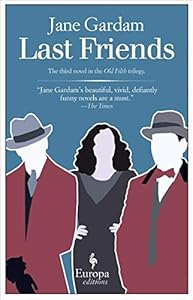
The satisfying conclusion to Gardams Old Filth trilogy offers exquisite prose, wry humor, and keen insights into aging and death ( The New Yorker) .
While Old Filth introduced readers to Sir Edward Feathers, his dreadful childhood, and his decades long marriage, The Man in the Wooden Hat was his wife Bettys story. Last Friendsis Terence Veneerings turn. His beginnings were not those of the usual establishment grandee. Filths hated rival in court and in love is the son of a Russian acrobat marooned in the English midlands and a local girl. He escapes the war and later emerges in the Far East as a man of panache and fame. The Bar treats his success with suspicion: Where did this handsome, brilliant Slav come from? This exquisite story of Veneering, Filth, and their circle tells a bittersweet tale of friendship and grace and of the disappointments and consolations of age. They are all, finally, each others last friend as this magnificent series ends with the deep and abiding satisfaction that only great literature provides.
[Gardams] prose sparkles with wit, compassion and humor. She keeps us entertained, and she keeps us guessing. Be thankful for her books. Be thankful for this trilogy, which is ultimately an elegy, created with deep affection. The Washington Post
Restores us to an era rich in spectacle and bristling with insinuation and intrigue. Vivid, spacious, superbly witty, and refreshingly brisk the story (and the author) will endure. The Boston Globe
All three Gardam books are beautifully written but its a pleasure to note that Last Friends is the most enjoyable, the funniest and the most touching. National Post Last Friends (Old Filth Trilogy Book 3)


Comments
Post a Comment