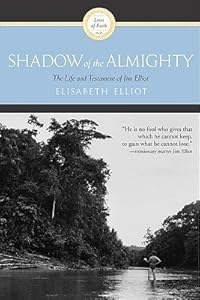
Shadow of the Almighty: The Life and Testament of Jim Elliot By Elisabeth Elliot
Jim Elliot's short, powerful life reminded me of what Christ's own life showed first: we are all born to die. It's up to us whether our lives simply peter out (result of the Fall and all that) or whether we find an altar, choose a cross, draw a line, pick an Alamo, raise a flag, and say, Here. For this. For this I will give my life. One decision, many moments, throughout all the life God gives us. 272 He is no fool who gives what he cannot keep, to gain that which he cannot lose.
This book could be read as a prequel to Through Gates of Splendor, also by Elisabeth Elliot. It is basically a biography of the life of Jim Elliot, from the perspective of his wife, his lengthy and detailed journals and his letters to his family/friends.
Jim Elliot's life was cut tragically short when he and four fellow missionaries were murdered by the Auca Indians in 1956 during one of their first outreaches to them. This story is told in Through Gates of Splendor.
On reading about Jim's school life and growing experiences, I was impressed with his dedication to personal holiness and spiritual discipline. Also, his desire to understand the Bible for himself through thorough study rather than relying on, and adopting the viewpoints of, other respected Christians. Most of us tend to do the latter, often to our detriment, especially when it comes to apologetics as we are unable to effectively express our viewpoints/defend our faith as we haven't studied it in sufficient detail, or been persuaded ourselves what we believe. Elliot diligently and persistently studied the Word often adopting viewpoints that went completely against the grain at the time. He refused to get involved in leading a political group in school. He sought also to use every minute of his time wisely and only got himself involved in those things that would forward God's Kingdom in some aspect or another. Through reading his diaries it is clear that his dogmatic views changed over time but his heart was always to follow Scripture regardless the cost to his personal reputation. We can all learn from his example.
Somewhat strangely Elliot seemed to become less effective/less dedicated when he actually went to a foreign mission field. Whether this was because he faced all kinds of difficulties; building swept away in typhoon weather, various deaths, potential colleagues marrying and remaining at home, or whether it was because God was expecting him to live more by faith as he matured spiritually, I don't know.
His decision to go into Auca territory with the other men is an interesting one. I'm sure this has been debated endlessly. The author (his wife) was at first unsure and asked him whether he was sure that God led him into this decision. He confirmed that this was the case and then proceeded. Whether or not it was the right decision, I'm sure that Elliot believed it was and God has obviously used his testimony (and that of the others that died) for many years after his death. It is rare to read of someone so sold out for Jesus and this should be an inspiration/challenge to us all. Earthly things were of no consequence to Elliot and he spoke a lot about his frustrations in having to maneuver them.
You will wonder then why I'm only giving this 3 stars. Whilst Elliot's life was interesting and his devotional life a challenge I found the style of the book hard going and much too detailed in places. Lengthy journal extracts and letters about flora and fauna, Elliot's personal spiritual experiences, details of his growing attachment to Elisabeth, may be exciting reading for his wife and family but I found it a struggle not to lose interest. For his life and dedication I would rate it 4 stars.
Recommended for those with an interest in mission/missionaries. This is clean; free of bad language and sexual content. There is a little violence on the field and also some death scenes but nothing too graphic. 272 It is difficult to find a story that stirs the soul quite like Jim Elliot's. His life reads just like a novel, and yet is all the more compelling knowing it really happened. He was a husband, a father, a missionary, and a martyr by the age of twenty-eight; most people do not live such a full life. The author and wife of Jim Elliot tells his story primarily through his own letters and journal entries, rather than her own narration, allowing the reader to dig deep into the mind and heart of Elliot without the distraction of author bias. Her goal is to tell his story plainly, without dramatizing any points - not even his terrible and sudden death at the hands of the savage Auca Indians. It is Jim Elliot's poetry and eccentric writing style that give Shadow of the Almighty its novel-like appeal.
As with any biography, the reader is first and foremost acquainted with who Jim Elliot was, what made him the man he was by the time he died. However, just as Elliot chose a life dead to the attention and applause of this world, his story is not meant to persuade the reader to admire him, but the One after whom he patterned his entire existence. Every time I set the book down, I found myself thinking more intensely about what it means to be a follower of Christ. The book as a whole is essentially one man's example of true Biblical Christianity, something long forgotten in this country yet desperately needed.
I would certainly recommend this book both to Christians seeking a more noble vision for the believer's life and non-Christians who feel called to a greater purpose than what the world has to offer. Elisabeth Elliot's straightforward and unassuming commentary and Jim Elliot's inspiring, convicting words make this a very worthwhile read. Religion Spirituality, Parenting Families 4.5 stars (re-read)
One of my lifetime reading goals is to read through Elisabeth Elliot's oeuvre. I was delighted to find this audiobook available through my library, even more so because Elisabeth, with her steady, low, modulated voice, was the narrator. She so passionately loved Jim; her respect and affection shines both in her diction and in her voice. Jim's grasp of language was impressive; the descriptions of his travels were lyrical.
Jim Elliot. A dynamic and direct (and dogmatic?) man. His intensity, his burning zeal ... made me shift in my seat, a bit uncomfortable, I'll admit. I admire him. If he had lived to threescore and ten, would his tone have modulated, I wonder?
The way he made decisions, the dichotomy he made between spiritual and secular, and his rejection of the ceremony and pageantry of weddings were other areas that made me squirm. I was cheering when he loosened up the last half of his senior year at college.
The close-knit fabric of his family life as seen through his letters is lovely. I had forgotten that his dad was able to come to Ecuador to help him with some construction projects. What a precious gift that time was.
I was raised in the shadow of Jim and Betty Elliot. My family were part of the Plymouth Brethren chapel Jim had attended (whose complacency he complained about!) while a student at Wheaton College. Jim's uncle, a man who radiated enthusiasm and was ever so kind to me, was an elder; Jim's cousin currently employs several of my family members. I went to Bible college with Jim's niece. My Harper aunts were schoolmates with Betty Howard at DuBose, a boarding school in Florida. When my Aunt Betty died in South Africa, I inherited her personal effects. Among them, I found this picture.
Fun quote: He sought the help of older Christians in learning to live for God. And there were occasions when he asked them to pray with him. Of one of these he wrote, Had fellowship in prayer with Brother Harper and discussion of the things of God. A happy experience. <-- that's my Grandpa!
Next up to read is Valerie Elliot Shepard's book, Devotedly: The Personal Letters and Love Story of Jim & Elisabeth Elliot
I re-watched Elisabeth Elliot's funeral at Gordon College, throat-lumping through it all, especially relishing her brothers' reflections. English This book was difficult and troubling to read throughout since one knows the painful end from the beginning. It didn't help that the pages were filled with Jim's allusions to lives poured out for God early, for his own readiness for death. Was this premonition or youthful romance and bravado?
Beyond this aspect, however, I found the first two-thirds of the book down right disturbing on a personal basis. I felt that I did not like Jim Eliot and I suffered a dichotomy of soul to think that I did not like this fellow saint with whom I will spend eternity. I found him to be rather sanctimonious, as another reviewer has said, as well as judgmental and legalistic. I found his purple, King James-type prose to be pretentious and annoying. Throughout his college years he anguished and moaned about how sluggish and stale the American church was and how little worth was held in his studies or any other kind of work. He did not share the Reformed and Puritan views that all respectable work that is done as unto the Lord is wholly acceptable to Him. I found Jim's view quite snobbish.
Further, I was completely befuddled by his failure to ACT. I believe that this failure must have been directly influenced by his denominational (Plymouth Brethren) practices. Apparently, the Brethren are Quaker-like in their worship services. There is no appointed minister and everyone sits around waiting to be inspired to speak or read or sing. (Jim also shared in common with the Quakers a passivity which he felt precluded him from participation in the military or in government or civic affairs.) This waiting attitude seemed to bleed over into the rest of Jim's life. After he graduated from college he went home and kind of just helped around the house while he waited to be called to Christian service, even though he clearly had a keen desire to go to the mission field. It seems as if he was awaiting an engraved invitation to serve. He also spent years declaring that he must deny himself a wife, despite the fact that the Lord had clearly provided a woman that he loved and who also happened to be called to the same mission field as he. These pages and pages of self-denial tasted so much of self-flagellation that it became excruciating to read.
I so wanted to put this book down. I so dreaded and yet couldn't resist reading it. I was rewarded for my perseverance. When Jim finally allowed himself to ACT on the desires that God had put into his heart and the opportunities that God opened up for him, he blossomed like one of the flowers of which he was so fond. It became a joy and pleasure to watch him grow through the pages of his journal - to let go of that romantic, angst-ridden prose, and the bemoaning of his unfulfilled desires. It is very evident that the Lord placed the desire for mission work in Ecuador in Jim's heart. It was a joy to see Jim's happiness blossom. He still continued for a while to deny himself the wife God had placed right in front of him. The reasons he gave for his failure to act were that God had not allowed it. I am still bewildered at this. My belief is that if God puts a desire in our hearts and provides the fulfillment, he means for us to take hold of it, not to stand back and ask ourselves if this is what God wants for our lives. (With the caveat that the desired object meets godly and biblical prerequisites, which the mission field and the wife did.) It is still very unclear to me, when Jim accepted God's gifts, what it was that finally made it okay.
At any rate, Jim's personal and spiritual growth were so evidenced in the later pages of the book that one can begin to see the early parts as what they were - evidence of youthful angst, zeal and romance. Thank God that no one has access to any of the journals I may have written during that part of my life. Jim was growing into a wonderful husband and father and a man of God that could appreciate the gifts he had been given. I ache to think that some of that leftover zeal could have caused impatience in dealing with the Aucas, but as is true in all things, God had a plan and He was able to work good. 272
Shadow of the Almighty is a modern classic story of faithfulness, obedience, and martyrdom. It is the best-selling account of the martyrdom of Jim Elliot and four other missionaries at the hands of the Huaorani Indians in Ecuador.
Shadow of the Almighty has inspired Christians since its first publication in 1958. Elisabeth Elliot makes full use of Jim's revealing diaries to fill in the details of a life completely committed to God's service.
This story was reintroduced to today's audiences in 2006 thanks to the release of the film, End of the Spear, which tells for the first time the killings from the perspective of the Huaorani. Shadow of the Almighty: The Life and Testament of Jim Elliot
We talk a lot about discerning the will of God, but what about obeying it? Obedience to the Lord and submitting oneself to the Bible and the Lord are some of my biggest takeaways.
Like most dead Christians I choose to read about, it always serves as a check to my soul and reality. They lived with eternity on the forefront of their minds all the time. Shadow of the Almighty: The Life and Testament of Jim Elliot Rating is based solely on the writing. The format of telling most of Jim Elliot's story from his own words in journals and letters is effective, I suppose, but ends up rather dry. Oddly, I found Mr. Elliot's writing poetic and compelling at times. I wonder if Mrs. Elliot could have simply relied on his own words too much? Perhaps she could have summarized more events.
As for the person of Mr. Elliot . . .
One cannot read a biography without forming at least a cursory opinion of the subject. If the rating were based on my opinion of Mr. Elliot, it might be different. I think if I had known Mr. Elliot in real life, I would have found him rather sanctimonious and occasionally a bit of a thug. The account of him and his friend shooting a duck in Portland, only to find out that it was a pet duck, disturbed me--not because the duck died, but because the young men simply hid from the weeping owner and just prayed that she would be comforted. I find that thuggish behavior, but the tone of the book suggests that we should wink and shake our heads and say boys will be boys.
In addition, Mr. Elliot made it clear that he would register as a conscientious objector should he be drafted. I confess that I do NOT understand at all this religious objection to defending freedom. It's interesting to note that I read a biography of George and Martha Washington at the same time I read this biography, and I would consider George Washington to have had as deep and abiding a faith as Mr. Elliot had. Mr. Washington, however, considered it an obligation to serve his country by defending the budding United States from tyranny--and indeed, several prominent Quakers left their sect and their pacifism to fight against the British in the Revolutionary War. So while I suppose I can respect Mr. Elliot's strength of conviction, I do not understand it, and I suspect that he would have been mightily offended by Mr. Washington's ability to reconcile his faith with serving in war.
On the other hand, I have the deepest and most profound respect for Mr. Elliot's service to the kingdom of God. And I confess--as one who does not experience the voice of God except through His Word, I am rather jealous of someone who could be so completely convinced of his calling and his duty. In addition, I think that his assessment of the church in America was deadly accurate, and I found his criticism of the way we practice Christianity here a biting indictment that has only proven itself even more true in the intervening decades since he penned his comments. Finally, while I did find Mr. Elliot personally a bit offensive (really? He couldn't change diapers because he believed in the division of labor? And he considered staying with his daughter babysitting?), I also do believe that he seemed to be growing into a more mellow, more palatable person as he aged. Had he lived past the age of 28, he may have eventually been someone that I could have tolerated in adulthood.
In any case, I'm glad I read it, and I will likely make time to read Through the Gates of Splendor eventually. Religion Spirituality, Parenting Families I love this book. It is one of my all-time favorites as it describes the short life of a man whose motto was the very Kingdom centered He is no fool who gives up what he can not keep to gain that which he can not lose. The passion and resolve of Jim Elliot to follow the leading of God, which for him was to the unreached tribes of South America, ultimately led to his death and the death of his four teammates as they tried to share the gospel with a dangerous yet unreached tribe.
Dying before his 30th birthday, his young life and the lives of the other missionaries sparked a great movement in churches in the 1950s to go to the ends of the earth with the gospel of Jesus Christ. This biography gives more specific detail about the inner thoughts, feelings, and decisions that Jim Elliot nurtured and inspire all who read it to want more from this life than what this world can bring.
Thanks to his wife Elizabeth for writing his biography and thank you God for giving us a young and zealous life, in the spirit of Stephen in Acts 7, to see that a life sold out to Jesus is still possible and needed in the world today. Religion Spirituality, Parenting Families He is no fool who gives what he cannot keep to gain what he cannot lose.
Jim left for me, in memory, and for us all, in these letters and diaries, the testimony of a man who sought nothing but the will of God, who prayed that his life would be 'an exhibit to the value of knowing God.'
This is an inspiring biography, and I don't use that description lightly. This book hit me with particular force because Jim Elliot was just a year older than I am right now when he was killed in missionary service. The passion and commitment to God he manifested up to that point was equally compelling, causing me to stop and evaluate myself. What am I doing with my life, however much of it God chooses to give me? Does it reach even 1% of the passion for God and for the lost that Jim Elliot had? Am I willing to give what I cannot keep to gain what I cannot lose? So, as one young person reading about how another young person devoted his life to pursuing the will of God and the glory of God among those who have never known Himâ â€"that is truly inspirational reading for me. By the world’s standards, Jim Elliot’s twenty-eight years were far too short. But he did much for the sake of the name in that time, and though he is dead, he still speaks. Thankful for biographies like these. Religion Spirituality, Parenting Families An amazing book of the faithfulness of God even in a man that did not live life long. Jim's life challenges me to live differently, more Christ-like, more devoted to the things of God and willing to go where he has been called. Some things I was challenged by included his patience waiting on the Lord for His will to be done in his relationship with Elisabeth (AKA Bets or Betty) and his move to Ecuador eventually. Religion Spirituality, Parenting Families


Comments
Post a Comment